
The Hidden Reason Children Struggle with Maths

Why do so many children struggle with maths? The answer might surprise you.
In this article, we’ll explore one key reason — and what parents can do to help.
The Problem
Parents who teach their children maths will likely recognise a familiar phrase — one that maths teachers hear regularly:
“I just don’t understand what this question is asking me to do.”
This feedback from students highlights the first challenge in solving many maths problems: understanding the question. A large proportion of the difficulty in maths arises from interpreting the language of the problem. Students must decode the text, identify the relevant information, and translate the wording into equations — a process that relies heavily on reading comprehension.
In this way, mathematics can partly be thought of as a language translation task. Students constantly move between words, symbols, and diagrams. This process requires understanding mathematical language, including unfamiliar vocabulary such as factors, limits, and functions. As a result, many misunderstandings in maths are actually misunderstandings of vocabulary.
As a teacher, I see this all the time with questions like: “List the first five multiples of 3.” Many students don’t know how to answer it. But if the question instead said, “List the first five numbers in the 3 times table,” they would answer it easily. The issue isn’t their number knowledge — it’s their understanding of maths vocabulary.
This same challenge shows up in most maths problems, particularly in exams such as GCSE mathematics, where questions are often presented in written contexts. To solve them, students must first understand the scenario being described and identify exactly what the question is asking. Only then can they break the problem into logical steps and carry out the calculations.
Below is an example of a worded question so you can see what I mean:
A school aims to increase the number of praise points awarded to students while reducing the number of homework detentions in a given year. To achieve these goals, they implement a school plan for the 2026 academic year.
By the end of the year, the number of praise points awarded had increased by 45%, and the number of homework detentions had decreased by 17%, compared with the previous school year, 2025.
By the end of 2026, students had received 20,300 praise points, and 664 homework detentions were issued. How many praise points and homework detentions were given in 2025?
As you can see from the example above, there’s a lot of information to decode before a student can answer the question.
The working memory model helps explain why poor reading comprehension can hold a student back in this situation. Working memory is the brain’s “short-term workspace” for holding and processing information — and it is limited to about 4 to 7 chunks of information at a time.
Let’s use the analogy of a learner driver. They must focus just to put the car into gear, leaving less attention for other tasks. An experienced driver, on the other hand, performs these steps automatically, freeing working memory for other aspects of driving. Similarly, if a student is using most of their working memory just to understand the question, less is available for doing the maths.
In my experience as a maths teacher, many students who struggle with problem-solving do not primarily struggle with the underlying maths concepts. Once the question becomes clear, they are often perfectly capable of carrying out the necessary calculations — whether adding, subtracting, multiplying, or dividing. In fact, calculations are often the easiest part, especially when students have access to a calculator, as they do in most exams and will do throughout life.
In short, one of the main barriers to problem solving is reading comprehension: if a student cannot clearly understand the problem, they cannot begin to solve it.
Prioritise Reading Comprehension
The advice to prioritise reading comprehension may sound strange in an article about teaching maths. However, educational research consistently shows that strong reading comprehension correlates with success in maths.1,2
In the UK, a recent study examined the relationship between reading ability and GCSE results across multiple subjects. The researchers found that higher reading ability was strongly associated with improved performance in every subject.3 This finding is not particularly surprising. What is surprising is this: the relationship between reading ability and success was stronger for Mathematics than for English Literature.3
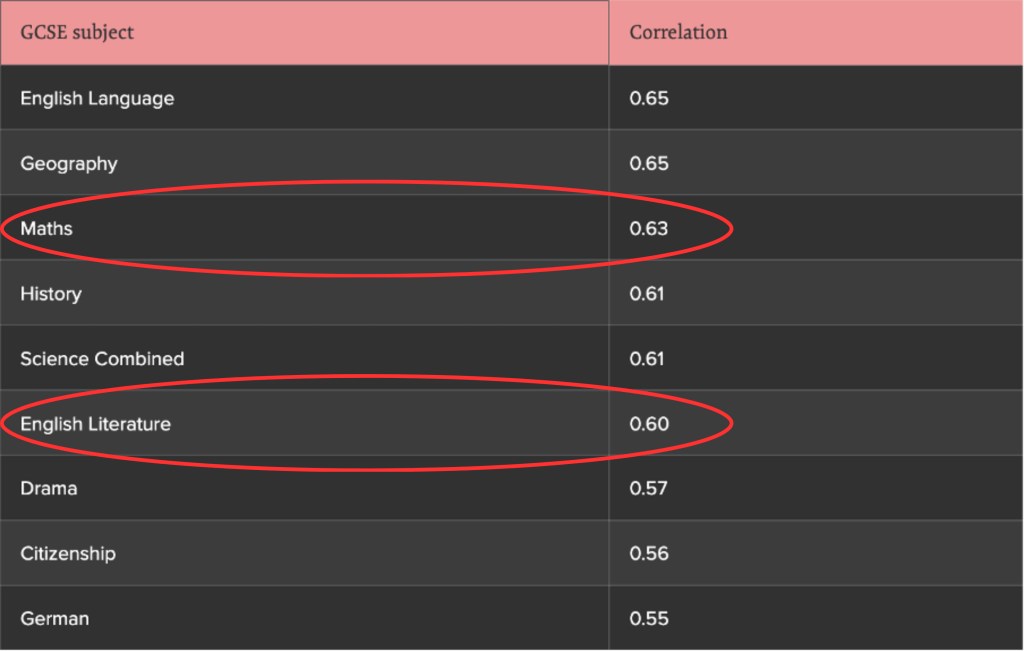
3GL Assessment, Why is Reading Key to GCSE Success, GL Assessment Report, 2020, screenshot of table,
https://www.gl-assessment.co.uk/reports/whyreading/why-is-reading-key-to-gcse-success/.
Reading Comprehension and Mathematical Problem-Solving
We have seen that reading comprehension plays an important role in success in mathematics. However, being a strong mathematician requires mastering several different skills.
This raises an important question: which areas of mathematics benefit most from strong reading ability?
A meta-analysis of 49 studies, covering over 37,000 students, found that reading comprehension was more strongly associated with mathematical problem-solving than with basic arithmetic.4 Similarly, another study showed that reading comprehension in 8–9-year-olds strongly predicted later success in problem-solving and understanding mathematical concepts, but had little impact on simple calculations such as addition or multiplication.1
The reason is straightforward. Solving worded problems and understanding mathematical ideas relies heavily on language comprehension, while basic calculations depend mostly on memorised procedures and number facts.
In short, strong readers tend to perform better at problem-solving and understanding concepts, while reading comprehension has less influence on a student’s ability to carry out basic calculations.
Practical Takeaways for Parents
Here is some teaching and learning advice parents can apply when helping their children.
When a child is struggling with a maths problem, it’s tempting to jump in and show them what to do — and sometimes that is necessary. However, in my experience, simply rephrasing the question and unpacking what it means — without explaining how to solve it — is often enough to help the child. If we immediately tell children what to do, we end up doing the difficult thinking for them! This leaves them to carry out the basic calculations and as we’ve seen, this is rarely where the main learning is found.
If rephrasing the problem doesn’t work, asking a well-chosen question can guide the child to think in the right direction. If neither approach helps, then show them how you would begin the question.
To be clear, this advice is not about avoiding direct teaching of content and letting children figure out everything for themselves. It applies specifically to problem-solving, where the relevant content has already been taught and the child is using concepts they already understand.
How to Improve Reading Comprehension
Given how important reading comprehension is for success in maths, the natural question arises: how can we help our child improve their reading skills? Here are some ideas:
1. Read Great Books that are slightly above their comfort level
The “Great Books” are a key component of Classical Christian Education. They are works that have stood the test of time and contain ideas that have influenced history. I’ve found that the Great Books are well-known for good reason. They often make me pause — sometimes all too frequently — thinking, “I read that, but I didn’t fully understand it.” In those moments, I know it’s time to slow down and re-read the line to fully grasp its meaning.
C.S. Lewis famously argued for reading books from the past:
“Every age has its own outlook. It is specially good at seeing certain truths and specially liable to make certain mistakes. We all, therefore, need the books that will correct the characteristic mistakes of our own period.”
When choosing a book for your child, aim for one they can understand roughly 80–90% of, but that includes words or phrases they don’t immediately grasp. This gently expands both vocabulary and their ability to navigate complex sentence structures.
For those interested in Classical Christian Education and the idea of the “Great Books,” I have included a link to a reading list from Classical Conversations at the end of this article.
2. Expand vocabulary deliberately
Vocabulary growth has one of the largest impacts on comprehension. Effective strategies include looking up unfamiliar words, keeping a short vocabulary list (including maths terms), and using spaced-repetition apps. Just five new words a day adds up to 1,825 words in a year!
3. Read slower when needed and re-read
It’s common for children to read quickly without fully understanding the text. Encourage your child to slow down on complex passages and re-read difficult sentences. From my experience reading with classes, I often have “light bulb” moments when I suddenly grasp what the author is intending. At those moments, it feels natural to pause and ask the students a question about the text. This not only clarifies the meaning for them but also keeps them engaged with the story.
When it comes to reading comprehension, I like the phrase “a consistent volume of thoughtful reading.” It captures two key ideas: first, the amount of reading we do really matters, and second, the reading should be thoughtful and challenging, not passive.
– Scott McDowell, Founder of Maths Logos
Thank you for reading! If you enjoyed this article, check out the video version.
In September 2026, we’ll be launching our online “Secondary Fundamentals” maths classes for home educators. You can try our free baseline assessment to see if the class is the right fit for your child here.
Classical Conversations Reading List
References:
¹ Grimm, R., Reading Comprehension and Mathematical Problem-Solving, Journal of Educational Research, 101(3), 2008, pp. 145–160.
2GL Assessment, New Study Highlights the Importance of Reading to the Whole School Curriculum, GL Assessment Press Release, 2020, https://www.gl-assessment.co.uk/press-office/press-releases/new-study-highlights-the-importance-of-reading-to-the-whole-school-curriculum/.
3GL Assessment, Why is Reading Key to GCSE Success, GL Assessment Report, 2020, https://www.gl-assessment.co.uk/reports/whyreading/why-is-reading-key-to-gcse-success/
4Akın, A., Is Reading Comprehension Associated with Mathematics Skills: A Meta-Analysis Research, International Online Journal of Primary Education, 11(1), 2022, pp. 47–61.